
Establishing a Controlled Human Hookworm Infection Model in Lambaréné, Gabon: a platform to foster the development of intervention against soil-transmitted helminths.

Establishing a controlled Human Hookworm Infection (CHHI) Model in a sub-Saharan African setting where STH infections are highly endemic is unprecedented.  The CHHI in Africa (CHHIA) is essential to fulfil several unmet scientific objectives. 

  1.  Genomic and post-genomic characterisation of local strains of Hookworm 

  2. Production of stage 3  Necator americanus larvae  from naturally infected donors living in Lambaréné ( L3 Lambaréné Na larvae), that will meet the criteria of an investigational product: clean, safe, Good Manufactory Practice( GMP) compliant and medical grade product ( batch specifications are phenotypic classification, potency of infectivity, parasitism and immune escape) 

  3. Identification of the infective dose of L3 Lambaréné Na and safety profile of CHHIA

  4. Cryopreservation of L1-L3-produced larvae

  5. Screening of new or improved vaccine targets using antibodies to protein arrays of Necator americanus L1-L3 larvae

  6. Investigation of vaccine adjuvant candidates through cellular immune responses, especially those with prominence in the activation of the innate response

  7. Screening of antihelminth resistance-breaking compounds 

  8. Accelerating clinical evaluation of promising antihelminth vaccine and drug candidates

Figure 1: Lambaréné human-controlled Necator americanus infection model. Clinical trial 1 is ongoing. Six out of the 15 participants have been enrolled.
Figure 2: Egg count determined by Kato-Katz method of controlled human hookworm infection with an inoculum of 50 Lambaréné Necator americanus third-stage larvae (NaL3) n=3 (2 inoculated and 1 placebo).

Safety and efficacy of the live chemo-attenuated Lamba-Na-L3 larvae hookworm vaccine against in adults living in Lambaréné: a randomised, controlled phase 1 clinical trial

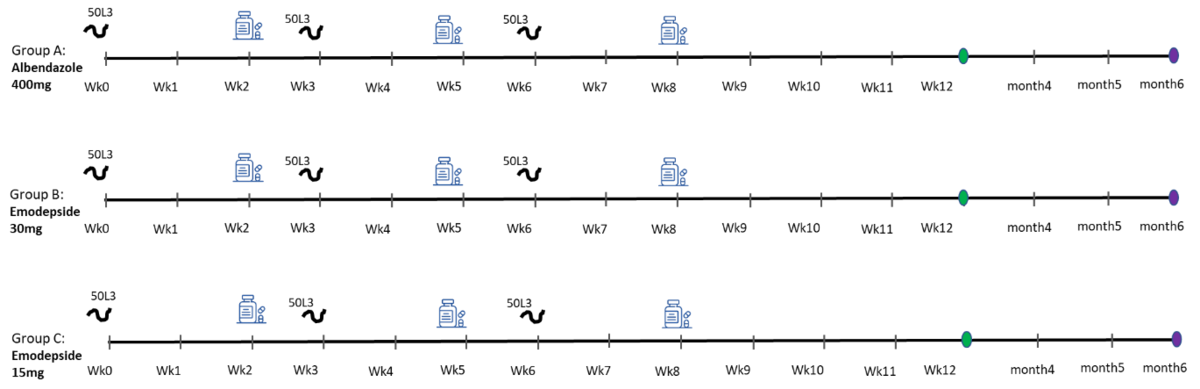
The Centre de Recherche Médicales de Lambaréné has established, the first ever in an endemic region, a controlled human hookworm infection model using local Necator americanus hookworm strains, a platform that will contribute to advancing the development of an effective vaccine. In two recent studies, attenuated L3 Necator americanus larvae have induced protection in a proportion of immunized people. In the present study, we aim to investigate whether chemo-attenuation with Emodepside, a drug that showed higher efficacy in clinical trials compared to Albedazole, will affect the attenuation of the larvae, resulting in better protection.We have designed a randomized, controlled, double-blind study to assess the safety and protective efficacy of the live chemo-attenuated Lambarèné-Na-L3 larvae against hookworm infection in adults living in Lambaréné. Participants will be infected with 50 Lambaréné-Na larvae and receive 30mg of Emodepside (experimental group) or 400mg/day for three days of Albendazole (control group) three weeks after the infection. All participants will be challenged with 50 Lambaréné-Na larvae 12 to 16 weeks after the first immunisation to assess the different chemoattenuated vaccine-induced immunity. The study will last about six months for each participant.

administration of antihelminthic drug
inoculation of 50 Lambarane Necator americanus third stage larvae

Trained and heterologous induced-immune responses to tropical infectious diseases: selection and validation of immune assays in children aged 1-12 years living in Lambaréné, Gabon.

Validation of ex vivo immune assays in children that are surrogates of complex in vitro assays to identify the occurrence, strength, and kinetics of trained and heterologous immunity may significantly impact public health. Such surrogate assays must be performed with a small volume of blood, little or no external stimuli, and output must be available within hours or a day. They may be considered for point-of-care testing and facilitate the triage of patients for specific care and treatments. They may be powerful tools for evaluating vaccines and drugs in clinical development by facilitating the selection of research participants for clinical trials and their eligibility to receive interventions. 

In this study, we translate findings from system biology approaches into contextualized in vitro and ex vivo assays in children living in settings where tropical infectious diseases are highly prevalent. We first reproduce the in vitro assays using culture of monocytes, co-culture of T cells and monocytes. These in vitro assays will be contextualized using peripheral mononuclear cells and whole blood. Finally, based on data from in vitro and in vitro contextualized assays, we select, test, and validate candidates' surrogate markers of trained immunity and heterologous immunity in children highly exposed to tropical infectious diseases.