


Research Programme
Infertility is on the rise, currently affecting more than 50 million couples worldwide – a prevalence similar to other common diseases such as diabetes. Hence, integrated research approaches investigating both the basic principles of reproduction and pathomechanisms of infertility are required. Fuelled by the DFG Clinical Research Unit 'Male Germ Cells' (CRU326) as well as the BMBF Junior Scientist Research Centre 'ReproTrack.MS' and supported by the University of Münster, we set out to take male reproductive research as well as the diagnostics and care of male infertility to a whole new level. This Collaborative Research Centre (CRC) – composed of basic and clinical scientists of the University, University Hospital, and Max Planck Institute Münster as well as one collaborator from the RWTH Aachen – shall take this endeavour further and establish a beacon of excellence focused on Unravelling the Molecular Mechanisms of Male Infertility.
The central objective of the CRC is, thus, to elucidate the genetic, molecular, and cellular mechanisms governing the formation and function of the testis, production and function of sperm, fertilisation, as well as early embryonic development – in both health and disease. To this end, we combine interdisciplinary research in molecular, structural, and cell biology as well as physiology, epi-/genetics, (bio)informatics, and multimodal data analysis. The major focus is on humans, capitalising on the close interconnection of medicine, clinical science, and basic science in Münster.
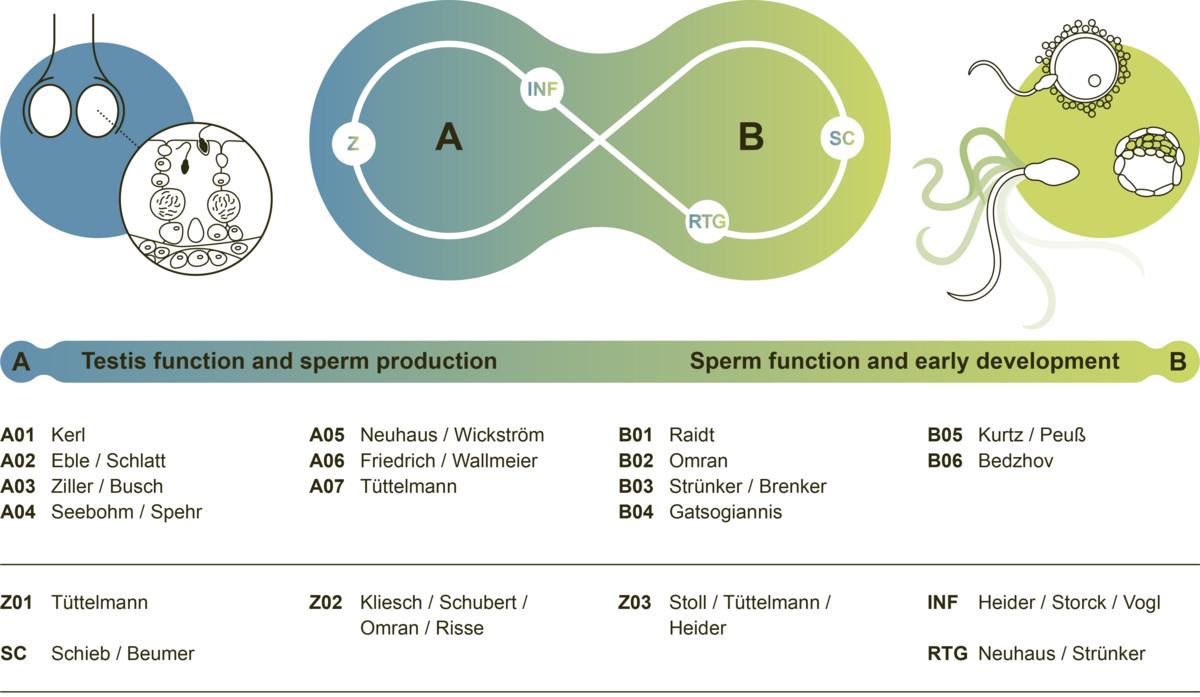
This unique setting enables projects on well-characterised human material, particularly from male patients suffering from infertility and related disorders, and promotes complementary projects on selected mammalian and non-mammalian model organisms, with both lines of research informing and advancing each other. Finally, pivotal central projects that interface clinics with science, generate and analyse genomic data, manage scientific and medical data, and disseminate information on human reproduction and infertility to the scientific community as well as the general public maximise the CRC’s scientific, clinical, and social impact.
Our mission is to Spur the Translation of Basic Knowledge into the Clinic to enable early diagnosis of male infertility as well as comorbidities, increase the fraction of evidence-based treatment decisions for medically assisted reproduction, and, thereby, improve the clinical care of infertile couples.