

Kick-off for SFB 1748 Reproduction.MS
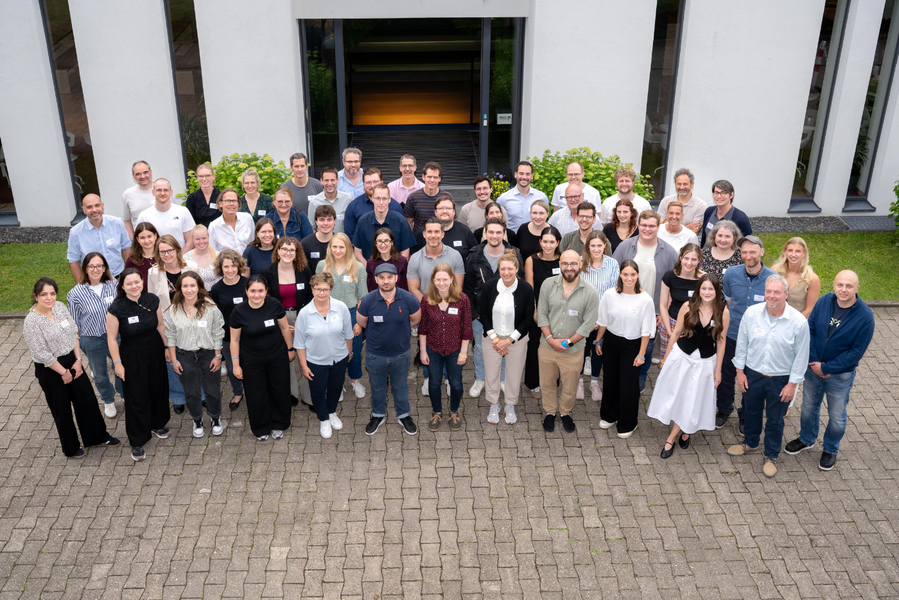
Members of the SFB 1748 ‘Reproduction.MS’ at the kick-off meeting in Münster.
The new DFG-funded Collaborative Research Centre "Reproduction.MS – Principles of Reproduction" (SFB 1748) has officially kicked off its first funding period. During last week's kick-off meeting, principal investigators and early-career researchers came together for an intensive exchange on the scientific projects and to lay the foundation for their future collaboration.
The meeting also marked the first gathering of SFB 1748's doctoral researchers, who officially launched the Research Training Group (RTG). Around 60 scientists from the University of Münster, University Hospital Münster, RWTH Aachen University and the Max Planck Institute in Münster engaged in lively discussions on various aspects of their collaborative research on male infertility. Beyond the scientific programme, the participants established the EDI Committee, Communications Committee, and Research Data Committee, while the Executive Board also convened for the first time.
The aim of the SFB is to elucidate both the basic principles of reproduction and pathomechanisms of infertility. The translational approach is enabled by the close interconnection of basic research and medicine in Münster. ‘More than 50 million couples worldwide are affected by infertility, in half of the cases, it is due to the male. The molecular causes are, however, still only ill-defined’, point out the spokespersons Frank Tüttelmann, Timo Strünker und Nina Neuhaus. ‘Our aim is to close this gap of knowledge.’ To this end, experts in molecular biology, cell biology, physiology, genetics, and computer science are investigating the genetic, molecular, and cellular processes that regulate testicular function, sperm production and function, fertilisation, and early embryonic development. The research draws mainly on samples from infertile men. The researchers aim to translate new scientific findings into clinical practice, enabling the early diagnosis of male infertility and associated comorbidities. This will allow to personalise treatment decisions, ultimately improving care for infertile couples.