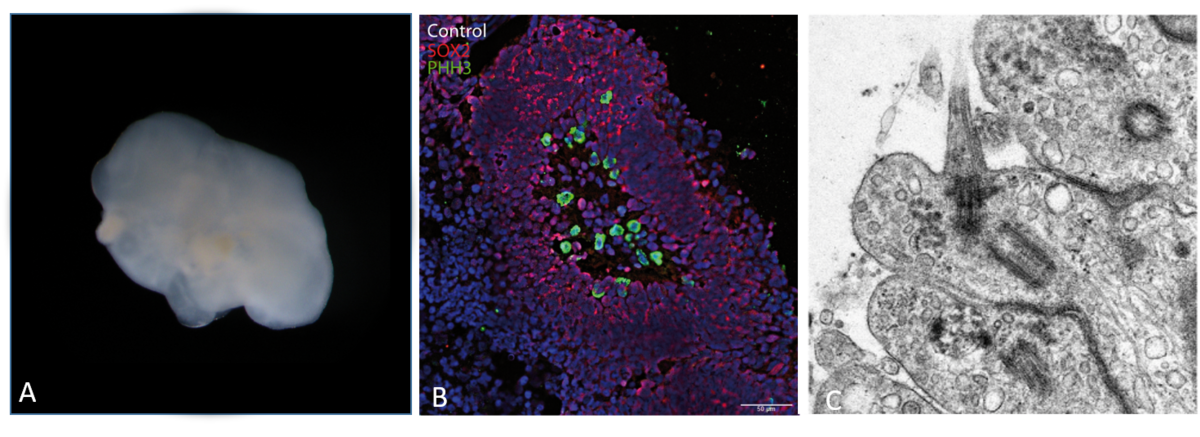

Cilia in early development (Group Wallmeier)
Advancements in sequencing technologies have greatly enhanced our ability to identify genetic variants. However, distinguishing which of these variants are truly disease-causing remains a significant scientific and clinical challenge.
Cilia are microtubule-based organelles found on the surface of many cell types and play essential roles in signalling pathways that regulate embryonic development, tissue homeostasis, and organ function. Disruption of ciliary structure or signalling can lead to a group of disorders known as ciliopathies, which often affect multiple organ systems, including the kidneys, eyes, brain, and skeleton.
We combine patient-derived samples with in vitro model systems, such as cell cultures and organoids, to conduct in-depth functional analyses at the RNA and protein levels. This approach allows us to assess the biological impact of specific genetic variants and their potential role in driving disease phenotypes. By elucidating the underlying molecular mechanisms, our work seeks to advance the biological understanding of rare diseases, with a particular emphasis on ciliopathies and ultimately contribute to more accurate diagnostics.