


Third Ceres Network Meeting in Hamburg
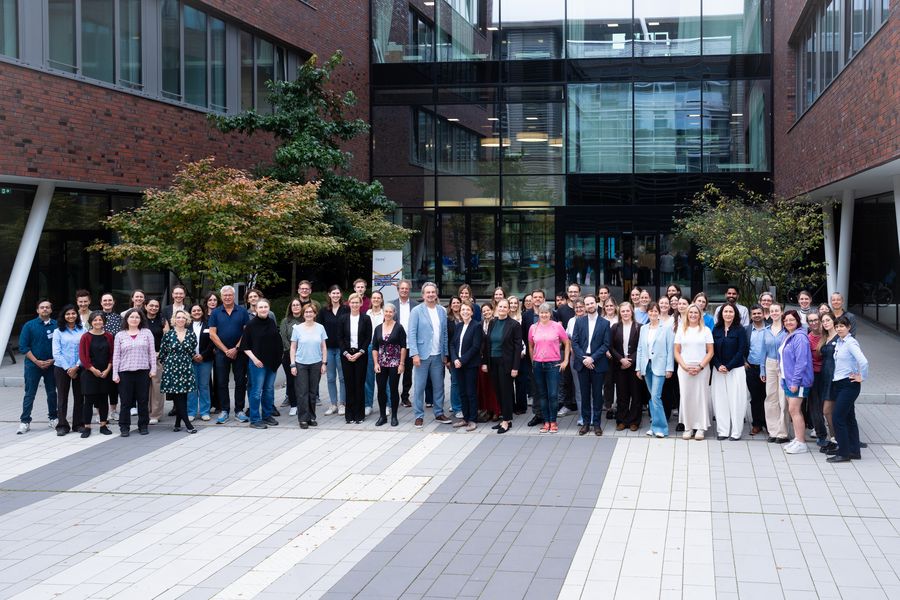
Ceres members meet for the third Network Meeting in Hamburg.
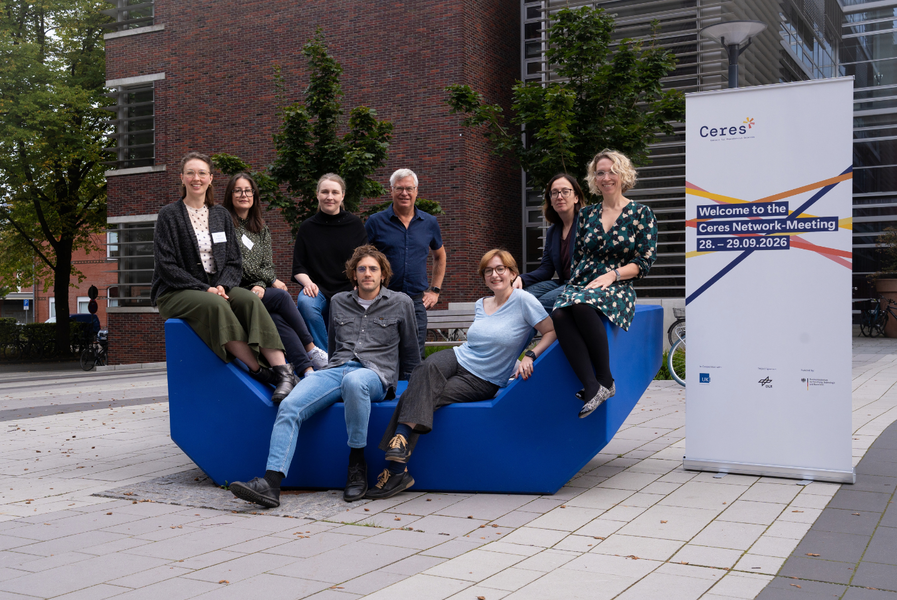
Janice Jeschke, Konstantina Kyriakopoulou, Nina Neuhaus, Mattia Anfosso, Jörg Gromoll (Network Reproduction), Sandra Laurentino, Carla Schieb, and Simone Bier (from left to right) represented ReproTrack.MS in Hamburg. Stefan Schlatt, Verena Nordhoff, and Martin Götte who also attended, are not pictured.
Münster / Hamburg - Clinician and Medical Scientists, principal investigators (PIs) as well as the coordinators from the five BMFTR-funded junior scientist research Ceres centres (Centres for Reproductive Sciences) came together in Hamburg for the third Network Meeting. Hosted this year by SRHOO at the University Medical Center Hamburg-Eppendorf (UKE), the two-day meeting provided a valuable opportunity for scientific exchange and networking.
A particular focus was on the scientific and structural development of the participating centres. Clinician and Medical Scientists from each centre presented their research progress in highlight talks, while also reflecting on the broader development of their respective centres. ReproTrack.MS Clinician Scientist Simone Bier presented her work on "Normozoospermia and infertility - risk factor for hypogonadism, comorbidities and a lower quality of life?". The subsequent poster sessions provided plenty of opportunities for in-depth discussions with fellow researchers and PIs and for exchanging ideas across institutional and disciplinary boundaries.
Beyond the scientific programme, the meeting offered opportunities to explore Hamburg and strengthen the network in a more informal setting. A guided tour of Hamburg’s Grüner Bunker provided fascinating glimpses into the history of the former air-raid shelter and its transformation into a unique urban space. For the Clinician and Medical Scientists, a workshop on Strategic Networking offered practical advice and food for thought on building professional connections and making effective use of the Ceres network and beyond.
The meeting also brought together the Ceres coordinators with representatives of the Federal Ministry of Research, Technology and Space (BMFTR) and the DLR Projektträger. Talks by Ruth Grümmer and Jörg Gromoll from the Network Reproduction provided additional perspectives and stimulated discussion on the development of the centres and the network.
The Ceres network was established in 2023 when five junior scientist research centres received funding from the BMFTR to strengthen early-career research in reproductive sciences. The network brings together SRHOO at UKE Hamburg, LE-REP at Leipzig University Hospital and the Helmholtz Centre for Environmental Research (UFZ), CEPRE at Jena University Hospital, FEPRO-ULM at Ulm University Hospital, and ReproTrack.MS at the University Hospital Münster and the University of Münster.
The annual network meetings are an important part of Ceres, creating space not only for scientific exchange but also for sharing experiences in establishing and developing junior scientist research centres. The third meeting in Hamburg once again demonstrated the value of connecting researchers, coordinators and funding partners across the network.