

The role of the Hippo signaling pathway in maintaining podocyte function

The function and morphology of podocytes are regulated by several signal transduction pathways, including the Hippo signaling pathway, which was originally described in Drosophila melanogaster. The activity of this pathway controls the localization of the pro-transcription factors Yes-associated protein (YAP) and its paralog, transcriptional coactivator with PDZ-binding motif (TAZ).
In post-mitotic podocytes, nuclear localization of YAP/TAZ is primarily crucial for cell survival. If YAP is absent in podocytes, or if nuclear YAP is exported from the nucleus due to reactivation of the Hippo pathway kinase LATS, podocyte cell death ensues. This behavior contrasts with that of mitotically active renal epithelial cells, where nuclear YAP/TAZ mainly promotes cell proliferation. Therefore, there must be specific regulatory mechanisms in podocytes that keep the Hippo pathway—particularly LATS—suppressed.
It has been shown that members of the Ajuba protein family (e.g., WTIP) can bind LATS to the actin cytoskeleton, thereby sequestering and inactivating it. Determining whether this is a key regulatory mechanism of Hippo pathway activity in podocytes is the central aim of this project.
The project is funded by the German Research Foundation (DFG, Project number 405968954) and conducted in collaboration with Dr. Dirk Oliver Wennmann.
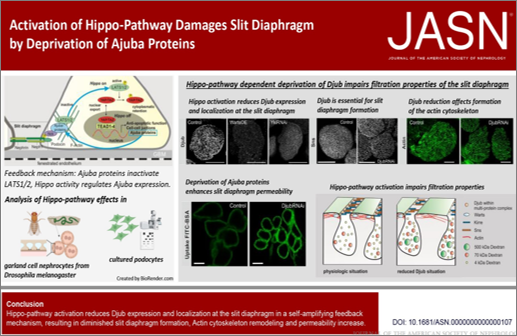
Gilhaus, Kevin et. al., JASN, June 2023
(Journal of the American Society of Nephrology 34-6:1039-1055; doi: 10.1681/ASN.0000000000000107)