


Milestone in Genetic Research: Scientists Discover New Cause of Rare Chronic Respiratory Disorder PCD
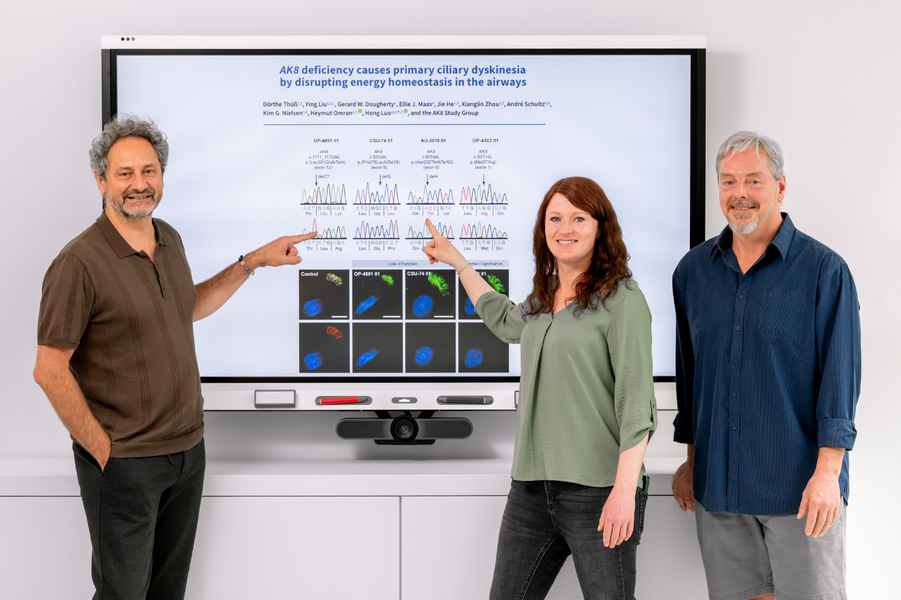
The research team from the Department of General Paediatrics at the University Hospital Münster (left to right): Prof. Heymut Omran, Dörthe Thüß, and Dr. Gerard Dougherty (Photo:)
Münster - An international research team led by the Department of General Paediatrics at the University Hospital Münster (UKM) has achieved a major breakthrough in the genetic diagnosis of rare lung diseases. For the first time, scientists have demonstrated that a deficiency of the enzyme adenylate kinase 8 (AK8) causes the rare inherited disorder Primary Ciliary Dyskinesia (PCD). Published in the prestigious American Journal of Respiratory and Critical Care Medicine, the study reveals that this genetic defect disrupts energy homoeostasis in the airways, failing the lungs' vital self-cleaning mechanism.
A Camouflaged Defect: When Cilia Run Out of Power
Primary Ciliary Dyskinesia (PCD) is a rare, chronic disorder where the microscopic hair-like structures (cilia) lining the airways fail to beat in a coordinated fashion. This typically manifests as a chronic wet cough, severe rhinosinusitis, recurrent lung infections, and irreversible lung damage known as bronchiectasis.
The unique feature of this newly discovered cause is that under traditional transmission electron microscopy (TEM), the ultrastructure of the cilia appears completely normal. “To date, approximately 30 percent of PCD cases lack a genetically confirmed diagnosis, which often means a year-long diagnostic odyssey for affected families,” explain authors Dörthe Thüß, Dr. Gerard Dougherty and Prof. Dr. Heymut Omran from the UKM. “Our work demonstrates that in AK8 deficiency, it is not the structural blueprint of the cilia that is broken, but rather their localised energy supply. The cilia simply lack the fuel (ATP) required for coordinated beating. Instead, they exhibit an abnormal, rotatory beat pattern that severely impairs mucociliary clearance”.
Successful Validation Through High-Tech Diagnostics
Utilising state-of-the-art whole-exome sequencing, the consortium initially identified three young male patients with homozyguous, loss-of-function variants in the AK8 gene. By employing targeted immunofluorescence microscopy – a specialized technique where specific proteins are flagged to glow under a microscope – the team directly visualised the complete absence of the AK8 protein inside the airway cilia.
To immediately translate these findings into clinical utility, the UKM integrated AK8 into its diagnostic PCD gene panel. This quickly led to the identification of a fourth patient who had previously tested negative but carried an unclassified AK8 missense variant.
Notably, motility of sperm is also dependent on ATP, and AK8 deficiency also manifests as male infertility characterised by slow swimming sperm.
The functional mechanism was further confirmed using a newly developed CRISPR-Cas9 mouse model, which perfectly mirrored the clinical respiratory symptoms and ciliary alterations observed in human patients as well as male infertility.
Direct Impact on Clinical Care and Future Therapies
These findings have immediate implications for clinical practice. The AK8 gene will now be included globally in diagnostic panels for PCD. This allows patients with chronic respiratory symptoms and normal ciliary structures to receive a fast, precise genetic diagnosis. Early diagnosis is paramount to halting progressive lung function decline through targeted interventions such as intensive airway clearance therapy and early antibiotic use. Additionally, AK8-deficient men can receive timely counselling and guidance for family planning.
Alongside the University Hospital Münster, the study involved leading medical centres from China (Changsha), Australia (Brisbane, Perth), and Denmark (Copenhagen). The research was supported by the German Research Foundation (DFG) and the German PCD patient advocacy group Kartagener Syndrom und Primäre Ciliäre Dyskinesie e. V.
Scientific Publication:
Thüß D, Liu Y, Dougherty GW, et al. AK8 deficiency causes primary ciliary dyskinesia by disrupting energy homeostasis in the airways. Am J Respir Crit Care Med. 2026;212(9):2239-2243. DOI: 10.1093/ajrccm/aamag214.