

Neutrophils are central players during initial immune responses against invading pathogens, but their action is not exempt from generating secondary damage to the host. This simplistic view of neutrophils as a homogeneous population devoted to host defense appears incomplete, given accumulating evidence over last years. Indeed, advanced single-cell technologies have evidenced an unprecedent phenotypic and functional heterogeneity across developmental stages and tissue environments in both health and disease (Silvestre-Roig, 2016; Silvestre-Roig, 2019).
Neutrophil functional diversity can be entrained during development, mobilization to the circulation, and during their infiltration to the tissue. These processes involve shifts at the transcriptional, proteomic and functional levels that augment the functional properties in circulating neutrophils, while organ-specific features emerge after tissue infiltration. Neutrophil ontogeny - referred to as the developmental history of neutrophils from its origin at the progenitor level to its fully mature form - also plays a role in creating functional diversity (Hageb, 2025). Transcriptional, epigenetic, structural and metabolic variations along neutrophil differentiation and maturation, as well as alterations in the temporal dynamics of production and mobilization can drive this heterogeneity. Importantly, under pathological conditions neutrophils can further diversify with the acquisition of distinct, and even opposite, functions, ultimately promoting disease initiation and progression, and dictating outcome.
Our research focus is centered on understanding the origin, mechanisms, and consequences of neutrophil functional diversity in the context of acute and chronic vascular inflammatory diseases. We aim to identify cellular (ontogeny, maturation) and molecular (microbial, metabolic) mediators, contributing to neutrophil heterogeneity in different inflammatory contexts and organ-specific environments. Given the neutrophil-directed therapies often associate with increased susceptibility for infection, understanding neutrophil heterogeneity might be exploited to design refined therapeutic strategies to specifically target pathogenic subpopulations to prevent neutrophil-driven immunopathologies without altering host defense. To achieve these goals, we employ state-of-the-art techniques including spectral flow cytometry, multiplexed immunofluorescence, in vivo imaging, or single-cell epigenomics.
Our laboratory is currently centered on investigating the following research ideas:
- How organ-specific environmental signals control neutrophil production and dictates diverse functional specification.
- How neutrophils exert organ-specific anti-microbial functions to help the host against invading pathogens.
- How neutrophils contribute to bone marrow hematopoietic stem cell reprogramming to increase the predisposition for future secondary infections.
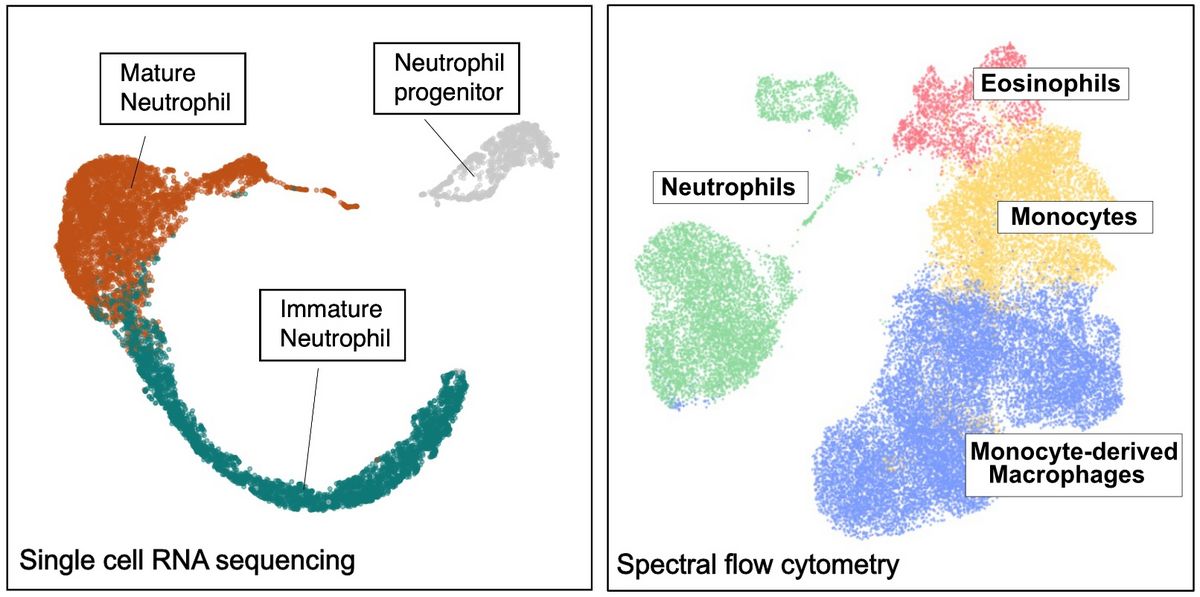
Right panel: Spectral Flow cytometry of peritoneal immune cells after bacterial infection.
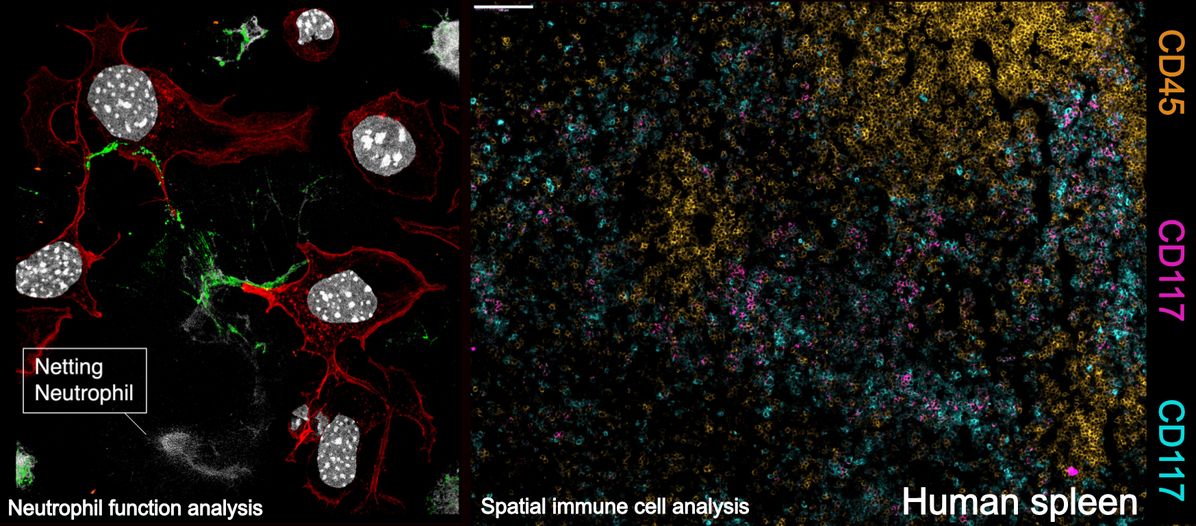
Right panel: Spatial immune profiling of neutrophil production in the human spleen.