
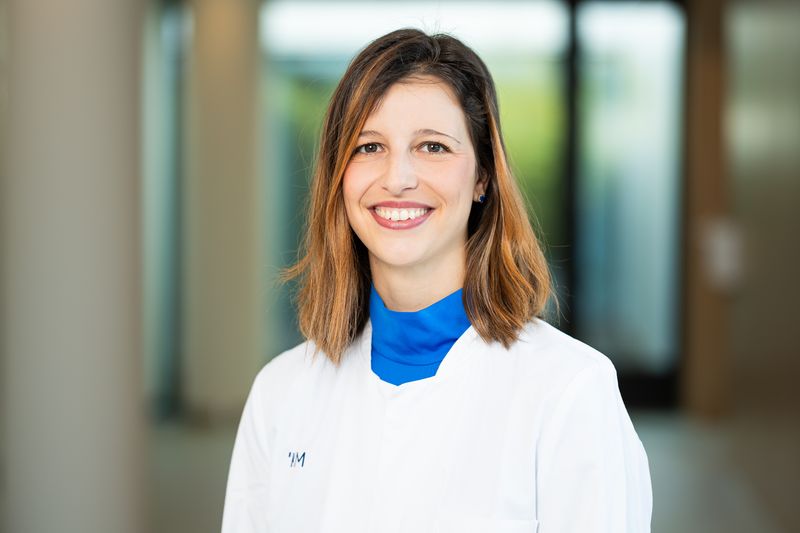
“I want to understand why treatments work – and why they give rise to side effects.”
28.05.2026
Dr Carolin Krekeler is a junior doctor at Medical Clinic A at UKM and has been a member of the Clinician Scientist CareerS programme since January 2024. In her work she combines clinical work in the area of haematology with translational research into innovative immunotherapies.
What fascinates you about research?
In my inpatient care I predominantly treat patients with haematological diseases such as leukaemia and lymphomas. Many of them receive highly innovative forms of treatment which are still being clinically developed. In many of these treatments which are being studied, we still don’t completely understand the mechanisms of how they work. Why does one patient respond well, while another doesn’t? Why do certain side effects occur? What motivates me is working on this very question in order to make treatment safer and better in the long term.
What are you currently researching into?
The focus of my project is CAR T-cell Therapy in the case of lymphomas: a patient’s own immune cells in the body are modified genetically in such a way that they can systematically recognise and destroy the cancer cells. One serious side effect of this therapy – and one that has not been fully understood so far – is the neurological complications. These can range from writing difficulties to comas. In my project I’m examining the hypothesis that, in combating the cancer cells, the T cells release lots of messenger substances which, in turn, overactivate the immune processes in the brain and thus trigger neurological symptoms. My aim is to gain a better understanding of mechanisms and to identify potential predictive markers or therapeutic approaches.
What are your plans for the future?
What I definitely want to do is pursue the combination of hospital work and research in the long term. In oncology, especially, bridging the two is essential if we want to rapidly transfer new findings to patient care. In all likelihood, I won’t be able to finish my current project within the funding period, so I will have to think about other funding possibilities in future. Irrespective of this, I would like to continue dealing with clinical topics from a scientific point of view – whether in the form of translational projects or of clinical studies.
This article was first published in the 2025 annual report of the West German Cancer Center Consortium.