

Phosphate Toxicity in CKD
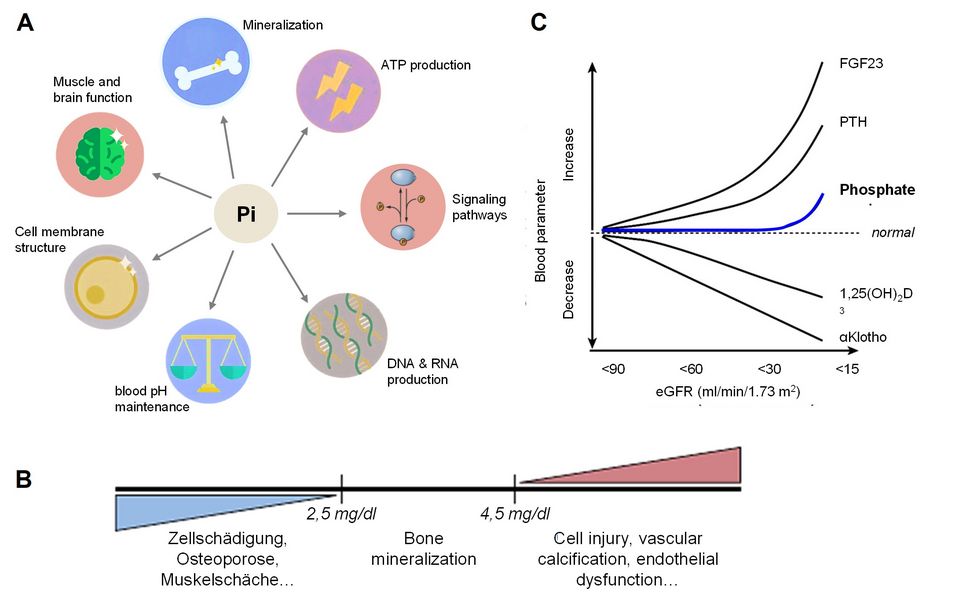
Phosphorus, in the form of inorganic phosphate (Pi), is a macronutrient essential for numerous cellular functions, including structural maintenance, energy production, metabolism, and signaling. Dietary intake, multiorgan crosstalk, hormones, and other factors work together to regulate phosphate and maintain normal serum levels.
As kidney function declines, circulating phosphate progressively increases, as observed in patients with chronic kidney disease (CKD). Excessive dietary Pi intake—particularly from processed foods containing phosphate additives—may further elevate serum phosphate independently of kidney function.
Hyperphosphatemia, as well as phosphate levels within the normal laboratory range, is strongly associated with increased cardiovascular disease risk and mortality in both the general population and patients with CKD. These effects may involve several interacting mechanisms, including altered endocrine signaling—likely increased fibroblast growth factor 23 (FGF23)—, calcium–phosphate crystal formation, local phosphate accumulation, and direct phosphate-dependent cellular signaling.
Our previous studies demonstrated that elevated phosphate directly impairs endothelial structure and function. This results in increased apoptosis, reduced angiogenic capacity, endothelial stiffening, and the enhanced release of endothelial extracellular vesicles (EVs) (formerly termed endothelial microparticles). Building on these findings, our current work investigates the biological activity of phosphate-induced EVs and the effects of phosphate on immune–vascular interactions.
Ongoing projects:
Phosphate-induced endothelial extracellular vesicles as mediators of vascular stress
This project examines whether EVs released by phosphate-stressed endothelial cells trigger inflammation and dysfunction in recipient cells.
A major challenge in studying phosphate-induced EV signaling is that elevated phosphate also promotes the formation of calcium–phosphate complexes. By employing controlled cell culture models, differential ultracentrifugation, and matched cell-free controls, we aim to isolate and characterize phosphate-induced EVs, distinguishing their functional effects from those of purely mineral particles or soluble mediators. Ultimately, this project will integrate EVs into the broader framework of mineral–vesicular signaling to determine whether they act as distinct particles or hybrid mineral–vesicular structures driving vascular injury in CKD.
Phosphate-induced metabolic reprogramming of macrophages
Monocytes and macrophages are central mediators of chronic inflammation in CKD, and their immune function—which is often dysregulated in these patients—is closely coupled to cellular metabolism. While the role of phosphate in vascular calcification is well established, emerging evidence links elevated phosphate directly to systemic inflammation and increased pro-inflammatory cytokines. However, the underlying cellular mechanisms remain poorly understood.
This project investigates whether elevated phosphate induces metabolic reprogramming in macrophages, thereby driving this inflammatory response. By integrating metabolic, molecular, and functional analyses, we aim to define how phosphate alters macrophage behavior and whether these changes causally contribute to endothelial dysfunction. Because CKD-associated immune dysfunction involves multiple uremic factors, isolating the specific effects of phosphate is critical to defining its specific mechanistic contribution to cardiovascular disease and uncovering new therapeutic targets.
Related publications:
Di Marco GS, Chasan AI, Boeckel GR, Beul K, Pavenstädt H, Roth J, Brand M. Monocytes as Targets for Immunomodulation by Regional Citrate Anticoagulation. Int J Mol Sci. 2024; 25(5):2900.
Hu MC, Shi M, Cho HJ, Adams-Huet B, Paek J, Hill K, Shelton J, Amaral AP, Faul C, Taniguchi M, Wolf M, Brand M, Takahashi M, Kuro-O M, Hill JA, Moe OW: Klotho and phosphate are modulators of pathologic uremic cardiac remodeling. J Am Soc Nephrol. 26(6):1290-302, 2015.
Phosphatregulation und kardiovaskuläre Konsequenzen – Was ist bei chronisch nierenerkrankten Patienten zu beachten? Brand M, Di Marco GS, Pavenstädt H. Dialyse aktuell 2015;19(S01):s6-s10
Di Marco GS*, König M*, Stock C, Wiesinger A, Hillebrand U, Reiermann S, Reuter S, Amler S, Köhler G, Buck F, Fobker M, Kümpers P, Oberleithner H, Hausberg M, Lang D, Pavenstädt H, Brand M. High phosphate directly affects endothelial function by downregulating annexin II. Kidney Int. 2013; 83(2):213-22.
Di Marco GS, Hausberg M, Hillebrand U, Rustemeyer P, Wittkowski W, Lang D, Pavenstädt H. Inorganic phosphate induces human endothelial cell apoptosis in vitro. Am J Physiol Renal Physiol. 2008;294(6):F1381-7.