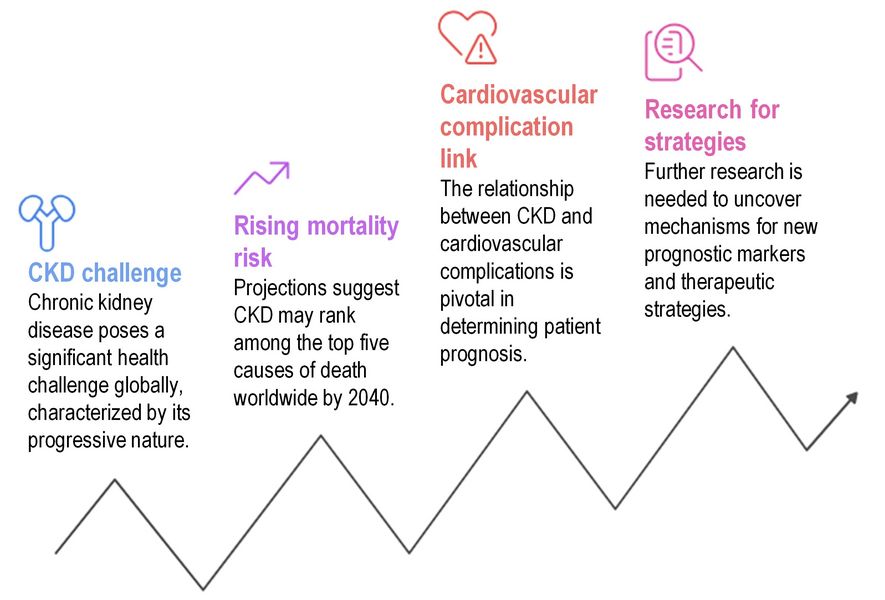
Chronic kidney disease (CKD) is one of the major health challenges of our time. It is not only a progressive disease, but also an important risk factor for numerous complications associated with substantial morbidity and mortality. Current estimates indicate that CKD is projected to become one of the five leading causes of death worldwide by 2040.
Cardiovascular complications substantially determine the prognosis of patients with CKD. Cardiovascular disease (CVD) is the leading cause of death in people with CKD. In addition to traditional risk factors such as age, diabetes, and hypertension, CKD-associated factors—including uremic toxins, inflammation, oxidative stress, and disturbances in mineral metabolism—contribute to endothelial dysfunction, microvascular rarefaction, myocardial fibrosis, left ventricular hypertrophy, and heart failure. However, additional mechanisms and risk factors remain insufficiently understood. Their identification may reveal new prognostic markers and therapeutic opportunities.
Our group focuses on the molecular and cellular mechanisms linking renal dysfunction with vascular injury, inflammation, and cardiovascular remodeling. We are particularly interested in how CKD-associated changes in the systemic environment affect endothelial cells, immune cells, microcirculation, and the heart. A major focus is the role of phosphate dysregulation and antiangiogenic factors in these processes.
Our research program is translational and integrates basic research, human-subject research, epidemiological analyses, and the systematic investigation of human biological specimens. We combine patient studies with mechanistic experiments in cell culture and animal models. This approach enables us to identify clinically relevant phenomena, define their underlying pathophysiology, and evaluate potential biomarkers and therapeutic targets.