

Endothelial Biomarkers and Endothelial Dysfunction in Acute and Chronic Kidney Diseases
The Endothelium: The Crossroad of Kidney and Cardiovascular Disease
The vascular endothelium is much more than a passive barrier; it is a highly active organ that regulates vascular tone, inflammation, coagulation, and tissue perfusion. In acute kidney injury (AKI), chronic kidney disease (CKD), and following kidney transplantation, endothelial dysfunction is a critical early event. The breakdown of endothelial health drives microvascular rarefaction, promotes interstitial fibrosis, and initiates maladaptive tissue repair. Alongside inflammation, a compromised endothelium creates a shared mechanistic pathway that mediates cardiorenal crosstalk, increasing vulnerability to further vascular insults and impairing the body's capacity for tissue repair.
Decoding "Vascular Signals" with Endothelial Biomarkers
To better predict patient outcomes and understand the underlying pathology of kidney disease, our lab investigates circulating endothelial biomarkers. Traditional clinical parameters and tubular stress markers often fail to capture the full scope of vascular vulnerability.
Our ongoing work aims to:
Improve our understanding of the regulation and release of endothelial biomarkers;
Investigate the relationship between sFlt-1, glycocalyx injury, and endothelial function;
Compare endothelial biomarker profiles across AKI and CKD to identify specific endothelial subphenotypes that drive the AKI-to-CKD transition;
Assess the integration of endothelial biomarkers into clinical risk models.
Related publications:
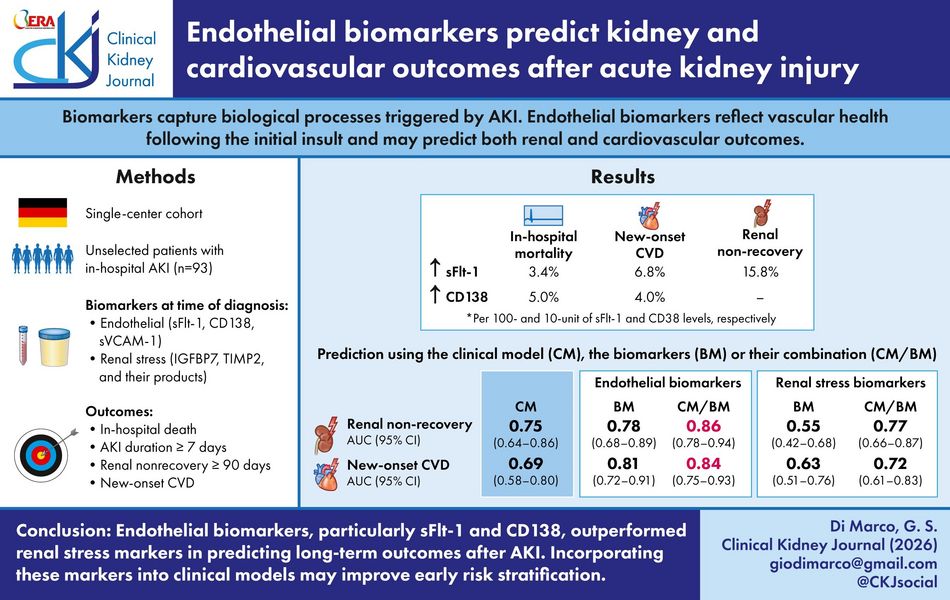
Di Marco GS, Beul K, Bormann E, Pavenstädt H, Brand M. Endothelial biomarkers predict renal and cardiovascular outcomes after acute kidney injury. Clin Kidney J. 2026; 19(9):sfag277.
Increased soluble fms-like tyrosine kinase 1 after ischemia-reperfusion contributes to adverse clinical outcomes following kidney transplantation. Kidney Int. 2019; 95(5):1091-1102.
sFlt-1: From Biomarker to Active Mediator of Microvascular Injury
CKD is characterized by a state of anti-angiogenesis, driven by the accumulation of factors that impair endothelial function and repair. A major focus of our research group is one such antiangiogenic protein: soluble fms-like tyrosine kinase 1 (sFlt-1). As the soluble form of VEGF receptor 1, sFlt-1 acts as a natural decoy that neutralizes Vascular Endothelial Growth Factor (VEGF), depriving the microvasculature of essential survival signals.
Through a highly translational approach—combining patient cohorts with in vivo and in vitro models—our lab has uncovered the dual role of sFlt-1 as both a powerful biomarker and an active driver of microvascular disease.
Related publications:
Schulz A, Drost CC, Hesse B, Beul K, Boeckel GR, Lukasz A, Pavenstädt H, Brand M, Di Marco GS. The Endothelial Glycocalyx as a Target of Excess Soluble Fms-like tyrosine kinase-1. Int J Mol Sci. 2023; 24(6):5380.
Schulz A, Drost CC, Hesse B, Beul K, Brand M, Di Marco GS. The soluble Fms-like tyrosine kinase-1 contributes to structural and functional changes in endothelial cells in chronic kidney disease. Int J Mol Sci. 2022; 23(24):16059.
Increased soluble fms-like tyrosine kinase 1 after ischemia-reperfusion contributes to adverse clinical outcomes following kidney transplantation. Kidney Int. 2019; 95(5):1091-1102.
Di Marco GS, Kentrup D, Reuter S, Mayer AB, Golle L, Tiemann K, Fobker M, Engelbertz C, Breithardt G, Brand E, Reinecke H, Pavenstädt H, Brand M. Soluble Flt-1 links microvascular disease with heart failure in CKD.Basic Res Cardiol. 2015; 110(3):30.
Di Marco GS, Reuter S, Kentrup D, Grabner A, Amaral AP, Fobker M, Stypmann J, Pavenstädt H, Wolf M, Faul C, Brand M. Treatment of established left ventricular hypertrophy with fibroblast growth factor receptor blockade in an animal model of CKD. Nephrol Dial Transplant. 2014; 29(11):2028-2035.
Di Marco GS, Reuter S, Hillebrand U, Amler S, König M, Larger E, Oberleithner H, Brand E, Pavenstädt H, Brand M. Soluble VEGF receptor Flt1 (sFlt-1) contributes to endothelial dysfunction in chronic kidney disease. J Am Soc Nephrol. 2009;20(10):2235-45.