
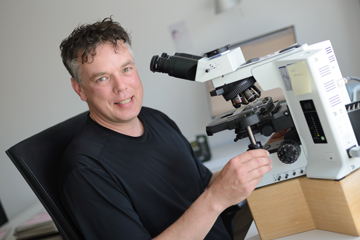
Prof. Dr. med. Martin Hasselblatt
Pottkamp 2
Tel.: +49-(0)251-83-56969
Fax.: +49-(0)251-83-56971
Research
Molecular Neuropathology of AT/RT and other SMARCB1- and SMARCA4-deficient Tumors
Pediatric central nervous system tumors remain a major clinical challenge. Despite intensive multimodal therapy, outcomes for many young patients remain poor. Atypical teratoid/rhabdoid tumor (AT/RT) is a particularly aggressive pediatric malignancy, defined by biallelic inactivation of the SWI/SNF chromatin-remodeling complex member SMARCB1, or less commonly SMARCA4.
Our laboratory is dedicated to advancing neuropathological diagnostics and deepening the molecular understanding of AT/RT and related SMARCB1- and SMARCA4-deficient tumors. We collaborate closely with international pediatric neuro-oncologists, molecular geneticists, and translational research groups. By integrating histopathology, molecular subgrouping, and clinical outcome data, we aim to refine risk stratification and support the development of more effective, biology-driven therapies for children with SWI/SNF-deficient tumors.
Molecular Neuropathology of AT/RT
Our current work focuses on collaborative diagnostic and translational research in AT/RT, with active participation in international research networks and registries. As a reference center for the European Rhabdoid Tumor Registry (EU-RHAB), we review and classify pediatric AT/RT cases, integrating histopathological, molecular, and clinical data to identify prognostic markers and continuously refine diagnostic criteria.
SMARCB1-deficient and SMARCA4-deficient tumors beyond classical AT/RT.
We also investigate rare SMARCB1- and SMARCA4-deficient tumors of the central nervous system and extracranial sites, including entities such as poorly differentiated chordoma and adult-onset sellar region AT/RT. A subset of malignant SMARCB1- and SMARCA4-deficient brain tumors with complex copy-number alterations may represent the first manifestation of Li-Fraumeni syndrome, providing a unique opportunity to study the role of p53 in genomic stability in AT/RT. Another major research focus is low-grade diffusely infiltrative tumors (LGDIT), SMARCB1-mutant. Although LGDIT, SMARCB1-mutant, displays deceptively bland histology, it carries a risk of malignant progression to AT/RT. We have assembled a unique case series and are investigating molecular mechanisms underlying malignant transformation. Understanding intrinsic and extrinsic factors that modulate susceptibility to SMARCB1 loss is expected to yield broader insights into tumor biology, resistance mechanisms, and disease progression in SWI/SNF-deficient neoplasms. Ultimately, this work aims to improve risk stratification and inform therapeutic decision-making.
Most of our research has been initiated by rare and unusual clinical cases. If you encounter an uncommon SMARCB1- or SMARCA4-deficient tumor in your practice, we very much welcome the opportunity to review the case for consultation.