

Network resilience towards psycho-social challenges
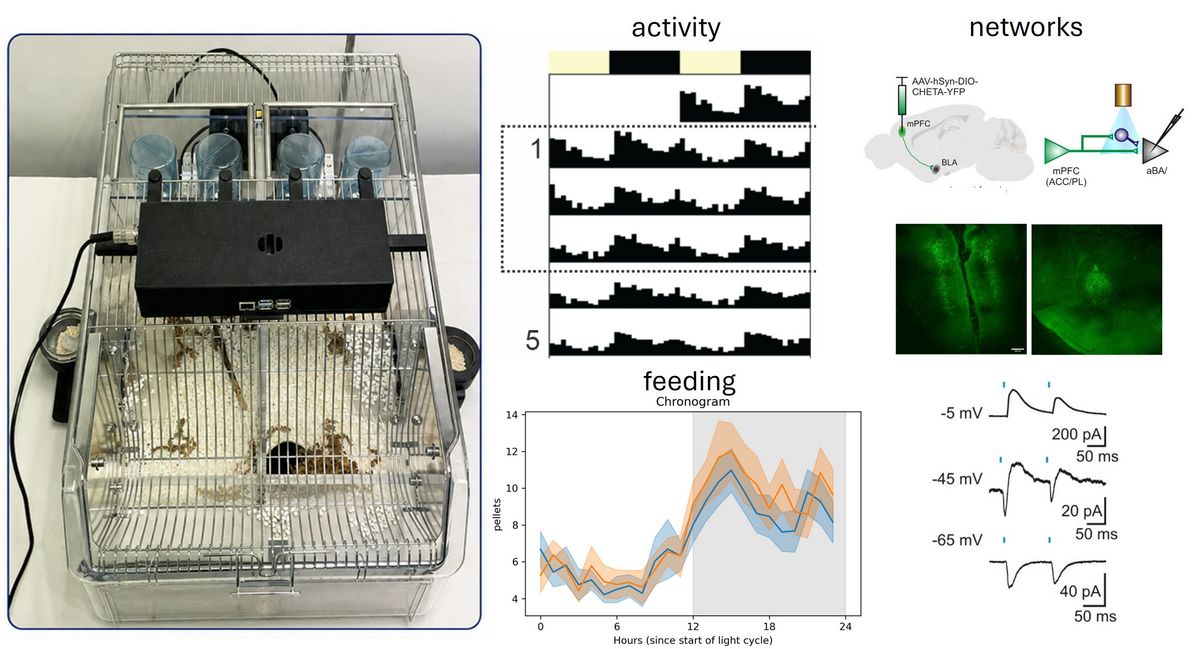
How does the brain remain stable or changes when it is challenged by stress, sensory overload, or emotional burden? In this research domain, we study how neuronal networks adapt to such challenges, and why some individuals develop symptoms while others remain resilient.
Our work focuses on animal-based models of neuropsychiatric disorders, especially ADHD and affective disorders such as depression. In one project, we investigate how excessive sensory stimulation during early life affects the developing brain and whether it can lead to ADHD-like symptoms, such as hyperactivity, altered attention, and increased sensitivity to sensory input. In this project, we also use humanized NPSR1 I107N mice to study how a human-relevant genetic variant may influence vulnerability or resilience to sensory overload. In another project, we study depressive-like behavior in wild-type mice and Cacna1c heterozygous mice, with a focus on how genetic vulnerability and chronic stress hormones interact over time. These questions are important because psychiatric disorders often arise from a complex interaction between genes, brain networks, environmental factors, and life experiences. Many of these processes cannot be understood by studying only single cells or isolated brain tissue. We therefore use mouse models that allow us to follow behavior and brain function in a living organism over time.
A central strength of our approach is the use of modern longitudinal technologies. With in vivo calcium imaging, we can observe the activity of defined neuronal populations in the living brain at high cellular resolution. In parallel, functional MRI allows us to investigate activity changes across larger brain networks. Importantly, both methods are applied repeatedly over several weeks. This makes it possible to follow the same animals over time and to ask whether changes in neuronal networks are only transient reactions to a challenge or become stable, long-lasting adaptations. For the study of affective disorders, we use longitudinal home cage observation systems. These systems allow us to monitor the animals continuously in their familiar environment with minimal disturbance. We can measure activity, circadian rhythm, feeding behavior, drinking behavior, reward preference, and other behavioral parameters over long periods of time. This is important because psychiatric symptoms do not appear only at one fixed time point. They develop gradually, fluctuate, and may recover. Continuous observation therefore helps us identify behavioral trajectories and early signals that may indicate the transition from a stable state to a disease-like state.
Our aim is to identify early signs of maladaptation and resilience. By understanding how brain networks react to sensory and psychosocial challenges, we hope to contribute to a better biological understanding of ADHD, depression, and related disorders. In the long term, this knowledge may help identify risk factors, disease trajectories, and new targets for prevention or treatment.