


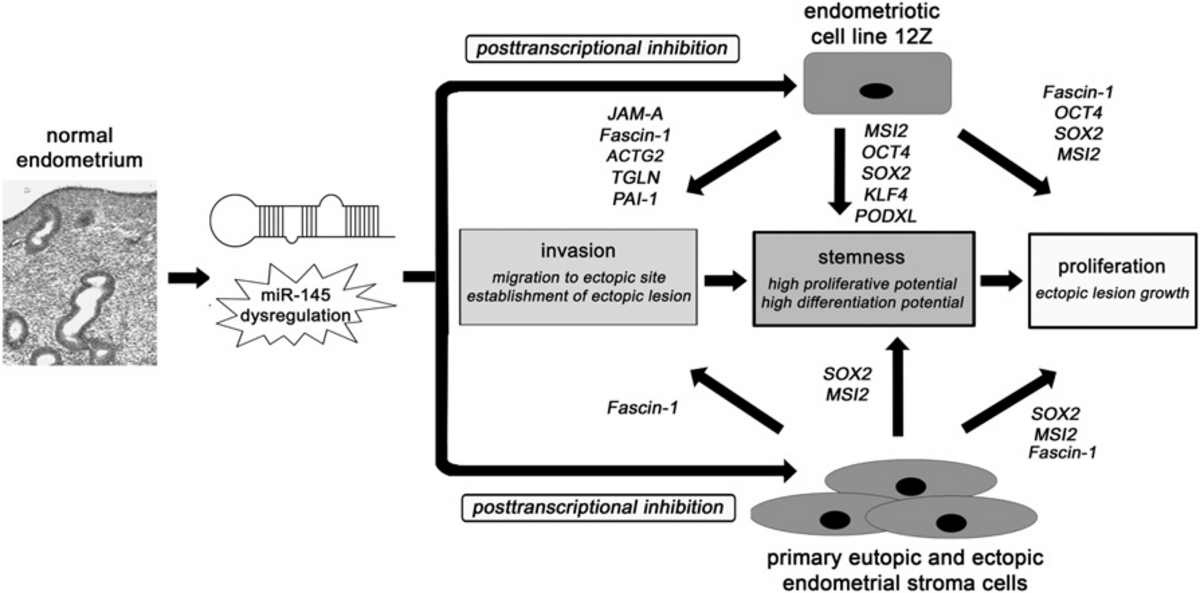
Key aspects of our previous work included the demonstration of an aberrant expression of adult stem cell and plutipotency markers in endometriotic tissue (1,2), a functional characterization of adult stem cells in the endometrium (3,4), and the demonstration of an endometriosis-promoting function of members of the syndecan family of transmembrane proteoglycans (5,6). Our most recent activities aim at deciphering a role for microRNAs in endometriosis. microRNAs (miRNAs) are small noncoding RNAs which regulate gene expression at the posttranscriptional level. Via interactions of their seed-sequence with the 3’UTR (or occasionally other regions) of target mRNAs, they induce either intracellular degradation of that mRNA by the RISC complex, or they hamper translation (7). Notably, the expression of miRNAs is dysregulated in ectopic and eutopic endometrium, of endometriosis patients compared to healthy tissue, suggesting a possible involvement of miRNAs in the pathogenetic process. The Götte laboratory has performed pioneering work in the functional analysis of microRNAs in endometriotic cell lines and primary endometrial stroma cells of endometriosis patients, leading to the identification of miRNAs which regulate invasiveness, proliferation, the proteolytic and inflammatory microenvironment and the stem cell phenotype of endometriotic cells (3,6,8,9).
Within the MOMENDO project, WWU will focus on the functional analysis of microRNAs, the extracellular matrix environment and adult stem cells as a prerequisite for the development of novel noninvasive diagnostic biomarkers and new therapeutic targets for this enigmatic disease.
References
1) Götte M, Wolf M, Staebler A, Buchweitz O, Kelsch R, Schüring AN, Kiesel L. Increased expression of the adult stem cell marker Musashi-1 in endometriosis and endometrial carcinoma. J. Pathol. 2008 Jul;215(3):317-29 2) Götte M, Wolf M, Staebler A, Buchweitz O, Kiesel L, Schüring AN. Aberrant expression of the pluripotency marker SOX-2 in endometriosis. Fertil Steril. 2011 Jan;95(1):338-41. 3) Adammek M, Greve B, Kässens N, Schneider C, Brüggemann K, Schüring AN, Starzinski-Powitz A, Kiesel L, Götte M. MicroRNA miR-145 inhibits proliferation, invasiveness, and stem cell phenotype of an in vitro endometriosis model by targeting multiple cytoskeletal elements and pluripotency factors. Fertil Steril. 2013 Apr;99(5):1346-1355.e5. 4) Schüring AN, Schulte N, Kelsch R, Röpke A, Kiesel L, Götte M. Characterization of endometrial mesenchymal stem-like cells obtained by endometrial biopsy during routine diagnostics. Fertil Steril. 2011 Jan;95(1):423-6. 5) Chelariu-Raicu A, Wilke C, Brand M, Starzinski-Powitz A, Kiesel L, Schüring AN, Götte M. Syndecan-4 expression is upregulated in endometriosis and contributes to an invasive phenotype. Fertil Steril. 2016 Mar 31. pii: S0015-0282(16)61039-7. doi: 10.1016/j.fertnstert.2016.03.032. [Epub ahead of print] 6) Schneider C, Kässens N, Greve B, Hassan H, Schüring AN, Starzinski-Powitz A, Kiesel L, Seidler DG, Götte M. Targeting of syndecan-1 by micro-ribonucleic acid miR-10b modulates invasiveness of endometriotic cells via dysregulation of the proteolytic milieu and interleukin-6 secretion. Fertil Steril. 2013 Mar 1;99(3):871-881.e1. 7) Sofo V, Götte M, Laganà AS, Salmeri FM, Triolo O, Sturlese E, Retto G, Alfa M, Granese R, Abrão MS. Correlation between dioxin and endometriosis: an epigenetic route to unravel the pathogenesis of the disease. Arch Gynecol Obstet. 2015 Nov;292(5):973-86 8) Eggers JC, Martino V, Reinbold R, Schäfer SD, Kiesel L, Starzinski-Powitz A, Schüring AN, Kemper B, Greve B, Götte M. microRNA miR-200b affects proliferation, invasiveness and stemness of endometriotic cells by targeting ZEB1, ZEB2 and KLF4. Reprod Biomed Online. 2016 Apr;32(4):434-45. 9) Kästingschäfer CS, Schäfer SD, Kiesel L, Götte M. miR-142-3p is a novel regulator of cell viability and proinflammatory signalling in endometrial stroma cells. Reprod Biomed Online. 2015 May;30(5):553-6.