

Successful participation in the MIE 2026 in Genoa
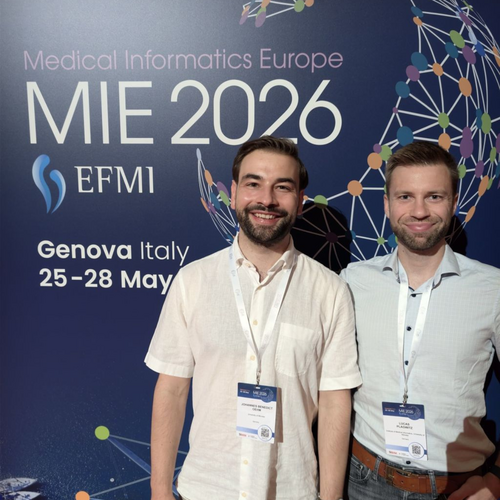
This year, the Institute of Medical Informatics at the University of Münster participated in the Medical Informatics Europe (MIE) conference, which took place in Genoa from May 25 to 28, 2026, with two contributions.
Lucas Plagwitz presented current research results on the generalizability of machine learning models between different ECG datasets and measurement methods. As part of the contribution "Generalization of ML Models Between ECG and VCG Representation", he investigated how well models trained on clinical 12-lead ECGs can be transferred to other signal representations. The focus of the study was on the transfer of ECG data to vectorcardiograms (VCG). The results show that the transferability depends significantly on the recording system used and that certain lead configurations enable particularly stable performance across different datasets. In the presentation, this approach was also extended to the transferability of clinical ECGs to smartwatch ECGs. The overarching goal of the research is to extract robust patterns from large and well-annotated clinical ECG databases and make them usable for alternative measurement forms. This should enable the potentials of modern AI procedures to be better exploited across different devices and application scenarios in the future.
Johannes Oehm presented the software component DicomShield, developed in Münster and published as open source on GitHub, as part of the contribution "DicomShield: A Pseudonymization Proxy for the Secondary Use of Imaging Data in the Research Context". DicomShield enables the separation between routine and research domains when accessing medical image data via the DICOM standard to be maintained without having to set up a cumbersome dual data storage. DicomShield pseudonymizes and checks patient consent on the way to the research domain, and also enables the conversion of DICOM metadata for FHIR-based data warehouse systems and access via modern DICOMweb interfaces, thus acting as a bridge between the DICOM and FHIR worlds. A particular focus in the development of DicomShield is the integration of pseudonymization and consent checking interfaces as well as FHIR profiles, which are currently being developed as part of the Medical Informatics Initiative (MII) and the Network of University Medicine (NUM). This allows DicomShield to be easily used at other data integration centers.