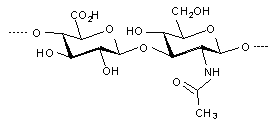
Hyaluronan has a very simple structure:
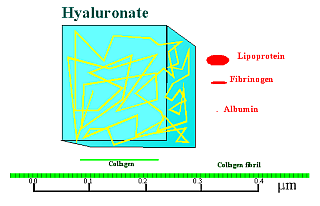
Size of different macromolecules
Almost every thing else is unusual: sometimes its role is mechanical and structural, as in cartilage, skin, synovial fluid, the vitreous humor or umbilical cord; sometimes it interacts in vanishingly small concentrations with cells to trigger important cellular responses. It has an unusual mechanism of biosynthesis and physical properties.Hyaluronan is widely sequestered in the extracellular matrix and that is secreted by many cells, especially fibroblasts and pathogenic group A and C streptococci. In fibroblasts it plays an active role in regulating cell behaviour such as random motility, chemotaxis, invasion, proliferation, shape, and metabolic reactions. In streptococci it is a major virulence factor.
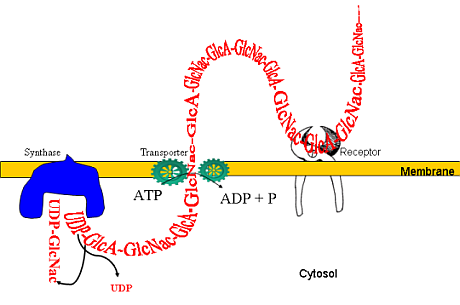
Mechanism of HA synthesis and export
Hyaluronan synthesis in mammalian cells differs from other polysaccharides in many aspects. It is elongated at the reducing end by alternate transfer of UDP-hyaluronan to the substrates UDP-GlcNac and UDP-GlcA liberating the UDP-moiety. It is synthesized at plasma membranes and nascent chains are directly extruded into the extracellular matrix. We discovered that hyaluronan is exported by the ABC Transporter MRP5 from fibroblasts and epithelial cells from CFTR.MRP5 belongs to the "multidrug-resistance associated" proteins which can expel cytotoxic drugs out of resistant tumour cells. Pharmacists have been developing inhibitors to increase the efficacy of cytotoxic drugs. Some of these inhibitors also inhibit hyaluronan export. However, these inhibitors were not specific to hyaluronan export. Therefore we searched for specific inhibitors, and finally found xanthohumol from hop extracts.The xanthohumol was immediately examined to see whether it can inhibit osteoarthritic reactions in cartilage. Osteoarthritis is often caused by joint trauma. It is a progressive degradation of a thin layer of cartilage on the articular surface. The cartilage has two main components: collagen and aggrecan. Aggrecan consists of two components: a chondroitin sulfate-proteoglycan, which is aggregated as the bristles of a bottle brush to a handle made of hyaluronan. In healthy cartilage, the synthesis of these components is finely tuned to each other. Hyaluronan overproduction is one of the first arthritic reactions. Proteoglycan production simultaneously decreases, and the proteoglycans are displaced from cartilage. The loss of the dense negative charge packing makes cartilage permeable to proteases. We found that xanthohumol inhibits hyaluronan overproduction while preventing aggrecan loss and collagen degradation. Thus a completely new biochemical approach has been found to inhibit arthritic reactions.We also discovered that hyaluronan is exported from epithelial cells by CFTR. CFTR is known as a chloride channel. It is one of the best studied proteins because a defect of this channel is responsible for cystic fibrosis. It is the most common genetic disease among Caucasians. However, many experimental findings could not be explained by the chloride export alone. Our work indicates that the viscous mucus of cystic fibrosis patients, which can not be coughed up, is due to a defective export of hyaluronan from the epithelium.Based on this knowledge we chemically synthesized membrane permeable compounds that are structurally similar to a disaccharide unit of hyaluronan (patent pending). These substances can correct the most common defect of the F508-CFTR and enable the export function.Finally, we found a new signal transduction pathway from the extracellular matrix into cells. Previously it was believed that the components of the extracellular matrix exert their effects on cells via specific receptors. Now there is another mechanism based on the Donnan effect. This effect states that an ionized macromolecule forces small ions across a membrane into the opposite compartment. This effect is particularly noticeable in high molecular weight hyaluronan and causes a reduction the membrane potential of neighbouring cells. The membrane potential is a fundamental property of all living cells and responsible for many cell functions, particularly for the nerve conduction. The brain is filled with large amounts of hyaluronan, whose function is still unknown. Thus, this finding is of great importance for cell biology.