


IMI presents research at GCB 2026
Saarbrücken, September 25, 2026
From the analysis of genetic and molecular processes to the application of artificial intelligence: The Institute of Medical Informatics (IMI) of the University of Münster was represented at the German Conference on Bioinformatics (GCB 2026) with a broad spectrum of current research topics. From September 22 to 25, 2026, researchers from Germany and abroad gathered in Saarbrücken to discuss current developments and methods in bioinformatics.
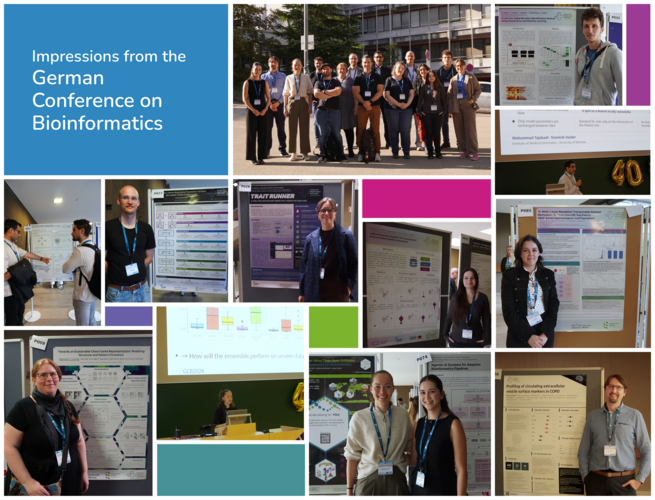
The IMI presented research results from various fields and contributed to the conference's scientific program with a presentation, a flash talk, and numerous poster presentations.
Presentation: “FourSynergy: Ensemble-based 4C-seq analysis framework using gradient-free optimization”
Sophie Wind presented FourSynergy, a new approach for analyzing interactions between different regions of the genome. Such interactions play a crucial role in the regulation of genes within cells. FourSynergy combines several computational methods to analyze and predict these interactions more reliably. The developed framework encompasses various tools, enabling the method to be applied to a wide range of research questions in bioinformatics.
Flash Talk: “Mind the Missing Split: Resolving Feature Heterogeneity in Swarm Learning with Random Forests”
In his flash talk, Arsam Tajabadi addressed a challenge in Swarm Learning. This approach allows multiple institutions to collaboratively develop AI models without exchanging sensitive data. A particular difficulty arises when the participating institutions possess different data and features. In such cases, a joint model may rely on features during evaluation that are not available at a specific site.
Tajabadi presented an approach that accounts for this so-called feature heterogeneity, enabling the application of the joint model even under differing local data conditions. This achieves superior results compared to methods that rely exclusively on shared features.
Poster Presentations
A Low-Cost, Rapid Microbial Identification Method Using Fluorescence and Machine Learning
M. Fujarski, M. Galvan, C. Beslendi, F. Schaumburg und J. Liesche
Agentic AI Systems for Adaptive Bioinformatics Pipelines
C. Schröder, M. Welzel und D. Heider
Bioconductor: More Than Software — A Vibrant Community for Open Bioinformatics
S. Wind, C. Chen, G. Deflandre und J. Spitzer
LoRA-Enhanced AmpGPT2 for Controllable Antimicrobial Peptide Generation
S. Clemens, T. Grebe, A. Eggemann, F. Schaumburg und D. Heider
Mind the Missing Split: Resolving Feature Heterogeneity in Swarm Learning with Random Forests
M. Tajabadi und D. Heider
Profiling of circulating extracellular vesicle surface markers in COPD
R. Martin, K. Laakmann, H. Pott, W. Bertrams, L. Hinz, I. Burhorst, R. Bals, C. Herr, P. Alter, C. Vogelmeier, G. Rohde, G. Schmeck und D. Heider
TE-Meth: Locus-Resolution Transposable Element Methylation Analysis from EM-seq Data in FACS-Sorted Spermatogenic Cell Populations
C. Parry, J. Paturlanne, S. Di Persio, S. Laurentino, N. Neuhaus, M. Welzel und D. Heider
TraitRunner: A tool for exploratory genotype-phenotype analyses
L. Ogoniak, A. Busch und D. Heider
Towards an Explainable Chaos Game Representation: Modeling Structure and Pattern Formation
H. F. Löchel, M. Grunert, S. Clemens und D. Heider
Towards a Unified Evaluation Framework for Deep Multimodal Fusion in Healthcare
P. Hahn und D. Heider
GCB 2026 provided the IMI team with a platform to present current research findings, gain new scientific insights, and maintain existing professional networks. At the same time, it created new opportunities for academic exchange and potential collaborations with researchers from both Germany and abroad.